


Intro to social media and content creation
In this blog I will briefly look at social media and content creation, in a next plannend piece I will take a closer look at social media use for football clubs.
What is social media?
Let’s discover a bit more how you would or could describe social media. Econsultancy already asked this back in 2009 and listed a good variation of definitions based on follower’s feedback (they asked the question on Twitter which is clearly a good example), it’s still interesting to go through the list: https://econsultancy.com/what-is-social-media-here-are-34-definitions/.
When searching online you find articles from authors like Christopher Penn. He described some four years ago on Medium his take on the media landscape which he divided in the old, new and social media. He saw social media as a subset of the new media and the difference the interactive nature of it all: https://medium.com/@cspenn/whats-the-difference-between-social-media-and-new-media-71f7f5ae1eea
You have visuals listing a whole bunch of social media tools split into several categories like: publishing, networking, collaborating and so on. I believe that distinctions are sometimes very vague. Another example is the Conversation Prism introduced in 2008, giving an overview and naming it conversational networks. It places the individual at the centre as a sign that everyone can now be an influencer.

You could fill pages of course, on Wikipedia (which is also in the aforementioned list) you read the following:
Social media are interactive computer-mediated technologies that facilitate the creation or sharing of information, ideas, career interests and other forms of expression via virtual communities and networks.
So you see that some terms like: interaction, networking, sharing etc. are coming back. There are so many examples and probably you will give it a little twist yourself. Definitions will change in the future for sure adding or deleting certain aspects.
Some thoughts I wanted to share:
- Old and new, digital and social media; as in other areas, maybe it’s time to drop it all and talk about media and have other distinctions then. Same for digital marketing, let’s call it just marketing (not the only one telling this of course).
- I’m hearing it every time, social media should be about a two-way communication, as that’s a difference with all the “old” media nonetheless. How many clubs, brands etc. are doing this and doing this in a good way, not only giving the occasional RT. And the whole advertising shift of social media fits definitely in the two-way communication and certainly not in the “old” broadcasting aspects.
- People want to talk to people (another theory we’re being told every time), not with brushed off corporate messages. So, you have the ones still doing that and then it opened a bottle of let’s call it ‘trying-hard-to-be-the-funniest-in-the-room-kind-of-content’. Is that bad? No, not necessarily, as long as you don’t exaggerate of course (as with everything).
- ‘Specialist’, ‘expert’ and other terms, they are saying not that much. I like an interview with Paul Rogers, Chief Strategy Officer AS Roma, on the ECA (European Club Association) website very much: https://www.ecaeurope.com/news/as-roma-breaking-the-social-media-mould/. In this interview he said: ‘I think a lot of people – so-called social media experts – always try to make things sound more complicated than they actually are.’ And continued then: ‘We simply do what we think is the right thing to do for AS Roma.’ Make sure to read the whole interview as AS Roma are doing great things (and no, you shouldn’t just copy that now, find your own voice).
- Content creation is a real craft nowadays and an aspect where you will find again a lot of theory (as you know theory is good, but social media and all things surrounding is no science of course). Thanks to the very same social media it’s easy to find examples, for instance by following hashtags on Twitter like #SMSport or #digisport and to get some inspiration to get you going. Or follow certain people like @mkobach or @OnlineRule.
- *Edit 01/05/2020 I've added a 6th point I came across on a blog piece from Jessica Smith. It builds further on the point above and I like the opening statement: "How could a rulebook be written for an industry that is continuously changing and evolving? It’s impossible. " Read the blog here as it's about social media lessons during these special times: http://socialnsport.com/social-media-lessons-during-an-unprecedented-time/Edit 01/05/2020*
A last point is the size of it all. Each year, there’s a comprehensive report from we are social and this year’s edition mentioned 3.8 billion active social media users in the world, an increase of 9.2% with last year’s figures. Massive.

Content creation and the sense and nonsense of measuring
Quite bluntly speaking you could divide content in planned and unplanned. Within your content calendar you can make a weekly or monthly planning defining the key messages you want to bring, the copy and possible visuals and the channels you would like to use. We all know there should be a reason behind posting a certain piece of content, is it giving information or persuading someone to take a certain action (like downloading an app, subscribing to a newsletter or reading an article) or is it just to have some fun, striking a cord with your audience, etc.
You will have defined your tone of voice or this can be just an extension of your culture. Is humour possible? Will you add memes, gifs, emoticons to support your messages? This will probably also depend on the region you’re targeting, take for instance a look at the Twitter accounts of German club Eintracht Frankfurt as they made a distinction between @eintracht_eng and @eintracht_us (go and spot the differences). You have English accounts from clubs like AS Roma, Bayern Munich and Leverkusen doing something quite different than what we were used to.
When defining the content buckets or themes for your content production you can look at it in different ways. Will you work with general categories like inspiration, fun, ‘how to’ content and so on or will you divide it straight away in: players, fans, sponsors/partners. Either way, you will build something that fits your club (it can be a combination) and then place your messages in one or multiple categories.
Unplanned content can be answering to a certain situation (think of top topicals), having the right answer ready for your rival or fan (or an answer to a bit of an unfriendly message, but be careful with this one). This can also be crisis communication. Make sure to have the right people in place and tools and technology can help, is it thanks to a Digital Asset Management system (e.g. to find photos – having a big archive in place) or content publishing tools to act quickly.
Some food for thought or base for discussion: should you take people from your socials to your website (or other owned channels)? Some will maybe say yes and I was probably convinced that it should be that way, but then you hear other voices and if people are following you why wouldn’t you just share the key information on your social media? A medical update can easily be shared on Twitter and the likes and of course you can still have website content with trainer and medical staff interviews, reaction of the player etc.
Should you measure all your efforts? On the one hand it makes total sense to know the results of your work, on the other hand don’t let the numbers lead you too much. The content you produce should still make sense of course, don’t just do it because you know you will get a lot of engagement, in the end those numbers don’t show the complete picture. Be careful with vanity metrics, hollow metrics that look nice on the surface but hold little substance like total amount of followers. It’s far more interesting to see how followers interact with your content. Defining your KPIs are important, but do it wisely; avoid KPIs like ‘publishing 10 tweets per day’ as they are easy to reach but don’t have any added value in the end.
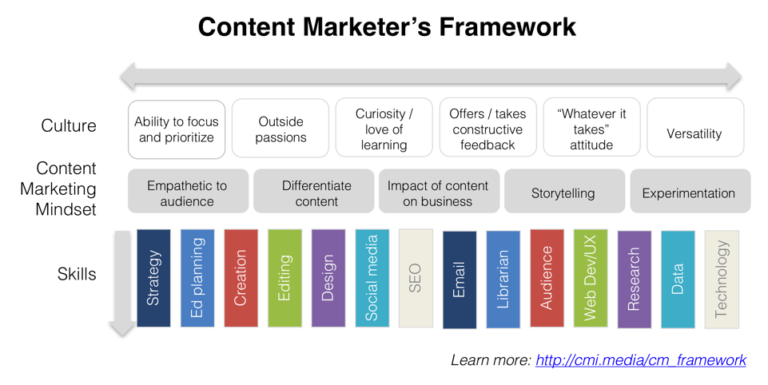
A last point I wanted to mention is about creating your ideal team and I'm referencing to a visual from Content Marketing Institute here. Read more about this framework on their website: https://contentmarketinginstitute.com/2017/11/framework-content-marketing-team/
There’s so much more to talk about of course and it will be interesting to see how it will develop in the future. If you want to discuss something, feel free to ping me on my socials or to send me an email.
Intro to social media and content creation
This article was posted by Jonas Bogaert on 04/03/2020 in:

About Jonas Bogaert
I'm a sports enthusiast with a special interest in fan experience, digital marketing, data and design. Follow me on Twitter @JonasBogaert.
Contact me